


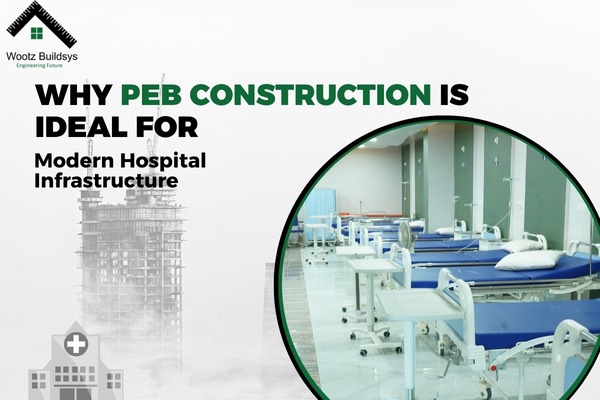
India’s healthcare sector is expanding faster than ever before, driven by rising patient volumes, rapid urbanisation, and the need for high-quality medical infrastructure across cities, towns, and rural regions. Hospitals today are not just treatment centres—they are complex institutions that require advanced facilities, controlled environments, and reliable structural systems capable of supporting sensitive medical technologies. In such a demanding environment, traditional construction methods often fall short, especially when quick expansion, hygienic construction, and long-term durability are essential.
This is why PEB Construction for Hospitals is gaining tremendous popularity. Pre-Engineered Buildings (PEB) provide hospitals with fast construction timelines, better space planning, improved safety in seismic zones, and the flexibility to expand or modify facilities whenever needed. For modern hospitals that are constantly evolving—adding new departments, increasing bed capacity, and introducing specialised wings—PEB structures offer unmatched convenience and speed.
This blog explores why PEB construction is becoming the preferred choice for medical institutions, the advantages it brings, and how it supports the future of healthcare infrastructure in India.
Why Hospitals Need Smarter Construction Systems
Hospitals face unique challenges that most commercial buildings do not. They must remain operational 24/7, adhere to strict hygiene standards, and ensure structural safety for patients, staff, and equipment. Moreover, healthcare facilities frequently undergo renovation and expansion as medical technology evolves.
Some key challenges include:
- Long construction timelines with traditional methods
- Dust, noise, and pollution, which can disturb ongoing patient care
- High labour dependency, leading to delays
- Limited flexibility for future modifications
- Need for seamless integration of HVAC systems, medical pipelines, and fire-safety networks
- Strict seismic and fire safety compliance
Traditional RCC construction can take years to complete, causing significant delays in operational readiness. In contrast, PEB construction offers faster, cleaner, and more controlled building processes, making it ideal for hospitals.
What Makes PEB Construction Ideal for Hospitals?
1. Rapid Construction for Faster Operational Start
One of the biggest advantages of PEB Construction for Hospitals is the speed at which structures can be completed. Since components are manufactured off-site in a factory, on-site installation takes only a fraction of the time required for conventional construction.
A hospital expansion that might take 18–24 months through RCC can often be completed in 6–8 months using PEB. Smaller facilities, such as diagnostic centres, ICUs, or emergency wards, can be assembled in weeks.
This speed is crucial during:
- Medical emergencies
- Natural disasters
- Pandemics
- Shortage of hospital beds
- Rapid infrastructure expansion for new medical departments
For healthcare organizations that need to scale quickly, PEB is unmatched.
2. Cleaner and More Hygienic Construction Process
Hospitals require controlled environments free from dust and noise. Traditional construction involves cement mixing, water curing, and heavy on-site fabrication, all of which create pollution and disrupt hospital operations.
PEB construction is primarily dry, which means:
- Minimal debris
- Almost zero water usage
- No wet processes
- Less noise
- Faster installation
This makes it the perfect choice for adding new wings to existing hospitals without disturbing patients.
3. Enhanced Flexibility and Future Expansion
Modern hospitals are dynamic structures that must constantly adapt. Whether it’s introducing a new imaging department, increasing ICU capacity, or adding a new floor, hospitals need construction that accommodates change.
PEB structures offer unmatched flexibility:
- Easy to expand horizontally or vertically
- Internal partitions can be modified effortlessly
- Structural components allow reconfiguration without heavy demolition
- Infrastructure upgrades like HVAC, ducts, or wiring can be added smoothly
This flexibility ensures that a hospital built today can continue to meet evolving medical needs for decades.
4. Seismic-Resistant and Safe for Critical Environments
India has several seismic zones where structural stability is crucial. Hospitals, especially those in earthquake-prone regions, must prioritise structural resilience.
Steel-based PEB structures offer:
- Better ductility
- Lower structural weight
- Strong load-bearing capacity
- Enhanced seismic performance
- Higher wind resistance
This makes them far safer than rigid RCC buildings during earthquakes. For critical environments like ICUs and operation theatres, structural safety becomes even more important.
5. Cost-Effective Construction with Long-Term Savings
PEB structures reduce overall project costs in many ways:
- Lower labour requirements
- No material wastage
- Faster construction reduces financial overheads
- Energy-efficient insulation lowers electricity bills
- Minimal maintenance costs
Hospitals also save money by avoiding long downtimes and delayed expansions. Over time, these savings make PEB an economically smart choice.
6. Perfect Compatibility with Hospital Utilities
Hospitals rely heavily on technical installations such as:
- Medical gas pipelines
- High-capacity HVAC systems
- Water filtration units
- Electrical and communication networks
- Fire safety infrastructure
- Laboratory exhaust systems
- Air purification and HEPA filters
PEB structures allow easy integration of these systems due to their open steel framing and flexible layouts. This ensures quicker installation, better accessibility, and easier maintenance.
7. Ideal for Specialised Medical Units
PEB construction is suitable for various types of hospital facilities, including:
- Emergency & trauma centres
- Multi-storey hospital buildings
- Outpatient departments
- Dialysis and imaging centres
- COVID isolation wards
- ICUs and NICUs
- Operation theatre blocks
- Rural healthcare units
- Rehabilitation centres
- Staff accommodation
Because fabrication is off-site, even remote areas with limited resources can benefit from high-quality medical infrastructure.
How PEB Construction Supports the Future of Healthcare in India
As India’s population grows and medical needs rise, public and private hospitals must expand rapidly. PEB construction directly supports:
- Large-scale healthcare projects
- Government health schemes
- Smart city medical infrastructure
- Mobile and emergency hospitals
- Rural healthcare development
- Affordable medical care facilities
India’s rapid push towards sustainable construction also aligns with PEB’s eco-friendly design, insulation options, and energy-efficient systems.
Hospitals built using PEB are not only faster and more cost-effective—they’re better designed for future demands.
Conclusion
The healthcare industry in India is undergoing a major shift, and modern hospitals require construction solutions that are fast, durable, clean, and adaptable. PEB Construction for Hospitals delivers all of these benefits, making it the ideal choice for building next-generation medical facilities.
With its superior safety, seismic resilience, customisation potential, and cost savings, PEB is transforming how hospitals are designed and built. As India continues to strengthen its medical infrastructure, Pre-Engineered Buildings will play a vital role in shaping efficient, modern, and patient-friendly healthcare environments across the country.
FAQs
1. Are PEB hospitals durable and long-lasting?
Yes. PEB hospitals are designed using high-strength steel and treated components that offer excellent durability and long service life.
2. Can PEB construction be used for multi-storey hospitals?
Absolutely. Modern engineering allows PEB systems to support multi-floor hospital infrastructure safely.
3. Is PEB construction suitable for infection-controlled areas like ICUs?
Yes. With proper insulation, wall panels, and HVAC design, PEB hospitals easily meet hygiene and infection-control standards.
4. How much time does it take to build a PEB hospital unit?
Small medical units can be ready in weeks, while larger buildings take significantly less time than traditional RCC construction.
5. Are PEB hospitals cost-effective?
Yes. Faster completion, lower manpower costs, and reduced maintenance make PEB hospitals highly economical.
link slot